Research
My research focuses on the economics of education, human capital development, and financial inclusion, with a regional focus on Colombia. I use quasi-experimental and experimental methods to evaluate the impact of infrastructure, technology, and policy interventions.
Publications
Polanco-Jimenez, J. (2025).
Road to the Future: Identifying Impacts of Roads on Education in Colombia.
International Journal of Educational Development, 114, 103173.
DOI
Abstract
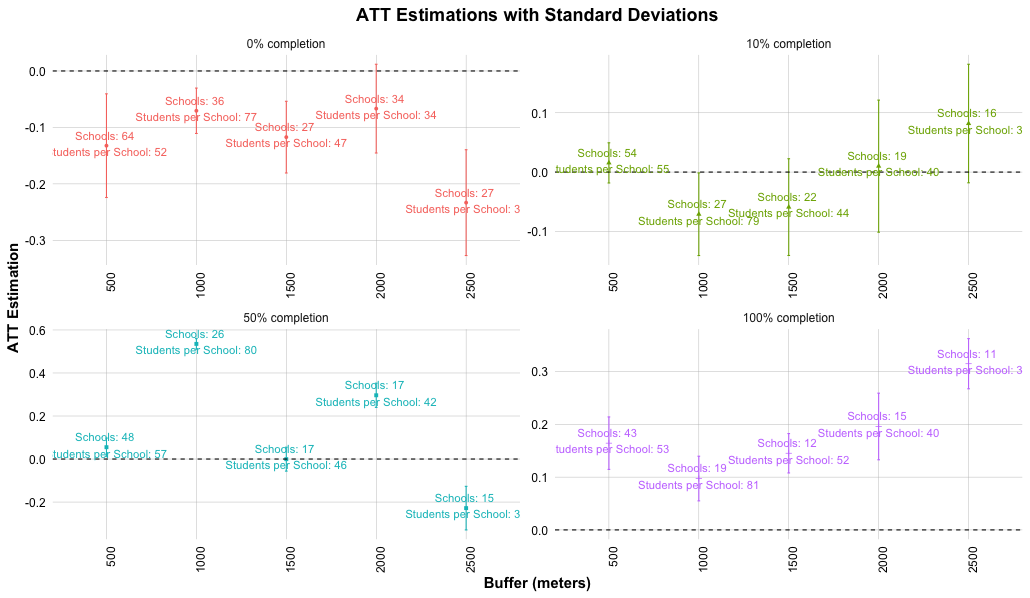
This study examines the impact of Colombia's road concession program on educational outcomes in public schools. Using a staggered difference-in-differences approach, I find that road improvements lead to a significant increase of 0.169 standard deviations in math scores, with the full effect materializing after project completion. Reading scores also show a positive, though less pronounced, trend. These findings are robust to various checks, including alternative estimators and control groups. Additionally, I observe reduced child labor participation and increased higher education pursuit following road improvements. This evidence suggests that Public-Private Partnerships-driven road concession programs can be effective tools for promoting human capital development in developing countries and that policymakers should consider the long-term educational benefits when evaluating infrastructure investments.
Polanco-Jimenez, J., & De Witte, K. (2025).
Factors Influencing STEM Participation and Effective Intervention Strategies.
NESET Report, Luxembourg Publication Office of the European Union.
DOI: 10.2766/4854833
Summary
Science, technology, engineering and mathematics (STEM) are increasingly recognised as critical drivers of economic competitiveness, innovation and sustainable growth in the European Union (EU). A robust STEM workforce is essential to address key societal challenges, including labour shortages, skill gaps, achieving the goals of the European Green Deal, and facilitating the digital transition. Investments in STEM education and careers are therefore crucial for securing the EU's future prosperity and global leadership. This report provides evidence-based insights to guide EU policies aimed at increasing participation in STEM, drawing on international research with a focus on the EU context. It identifies key factors influencing decisions to pursue STEM education across individual, social, and institutional levels.
View publication
Working Papers
Economics of Education and Development
The Tailoring Premium: How AI Design Unlocks Student Engagement and Learning (Job Market Paper)
with Kristof De Witte · Under Peer-Review at Journal of Economic Behavior and Organization
[PDF] · [Working Paper]
Does Coeducation Close the STEM Gap? Evidence from a Single-Sex Schooling Transition in Colombia
with Kristof De Witte & Gloria L. Bernal · Under Peer-Review at Journal of Development Economics
[PDF]
Black Gold and Dull Minds: The Impact of Oil Exploration Announcements on Education in Colombia
with Christian Posso
[PDF]
Local Oil Shocks and Student Trajectories: Evidence from Colombian Post-Secondary Education Choices
with Karen Castaneda
[PDF]
Financial Literacy and Small Business Development
Financial Literacy and Business Success: Evidence from an RCT in Colombia
with Johan Lozano
[PDF]
RCT Registrations & Ongoing Projects
Evaluating an AI-Powered Research Development Tool for Academic Productivity and Well-being
with Almudena Sevilla · AEA RCT Registry, January 2026
[Registry]
A Randomized Controlled Trial of an AI-Based Guidance Tool for Post-Secondary Planning
with Kristof De Witte · AEA RCT Registry, 2025
[Registry]
The Tailoring Premium: How AI Design Unlocks Student Engagement and Learning
with Kristof De Witte · AEA RCT Registry, 2024
[Registry]